The Wild West of Peptides: What You Need to Know Before You Inject (or Ingest)
It's late afternoon at your local wellness clinic or gym—or maybe you're scrolling on Instagram at home and see another influencer touting a "game-changing" protocol. They're injecting with this or they're boosting with that; maxing their gains or speeding recovery.
There's buzz like this about peptides everywhere these days. BPC-157. Ipamorelin. Melanotan II. They're whispered about as if they were secret weapons in the ultimate of all arsenals for recovery, fat loss, anti-aging, sexual function, and more.
You might even find yourself tempted to jump in. After all, if everyone else is doing it... right?
RIGHT?

Here's the thing you won't hear on that glossy promotional reel or from a supplement peddler: the peptide marketplace is running like an unregulated gold rush, and nobody's carrying a map.
The Numbers Don't Lie, but the People Who Profit Might
Here's the reality we're living in: The global supplement industry is now four times larger than Big Pharma - and Big Pharma's size is nothing to sneeze at. Within that massive, unregulated ecosystem, peptides have exploded from niche clinical tools into mainstream wellness commodities overnight. You can find them on websites with no physical address, sold as "research chemicals," delivered in plain packaging to your doorstep.
There's money involved.
A lot of money.
Which means there's motivation to move inventory faster than there is motivation to study the long-term effects. Or sometimes even the short-term effects.
Let's be honest about the reality: Most of these peptides have never been properly studied in healthy individuals using off-label protocols. Heck, many of them haven't been properly studied (or in some cases, studied almost at all) in thoughtfully-identified human volunteers under the premise of a clear benefit or goal.
Peer-reviewed literature exists for some established pharmaceutical peptide agents—the GLP-1s and insulins of the world (yes, insulin is a naturally-occurring peptide) used in diabetes management, for example. But those studies are conducted under at least some semblance of actual medical supervision, with specific dosing schedules and monitoring protocols, and in somewhat defined populations with clear-ish medical needs.
And still there are as many drawbacks and opportunities for harm with the most regulated pharmaceutical peptides out there as there are benefits: for example, with intermediate and long-term use, GLP-1s can damage the gut, contribute to lean muscle mass loss, and decimate bone density. For even the most well-studied and regulated pharmaceutical peptides out there, there's still so much we don't know.
What peptides people are buying online on the regular aren't those agents that require a prescription or oversight; that's not what's getting the most attention in Telegram groups and fitness forums. It's the unregulated stuff that comes bundled with uncountable unknowns and thousands of asterisks that's getting more and more of the attention out there.
As much money as regulated peptide compounds make (and that's an unreal amount), unregulated peptides stand to make much more—potentially exponentially more.
What Don't We Know About "Research Chemical" Peptides?
Actually, the better question to ask is probably: what DO we know about peptides being traded outside of regulated channels?
Not very much!
Because when you purchase a vial labeled something like "BPC-157" from an uncertified source—straight-up—you don't actually know what's inside.
None of this is meant to fear-monger; it's meant to inform and empower you. In medicine—and especially in integrative medicine, where we take body, mind, spirit, and story seriously—safety must come first.
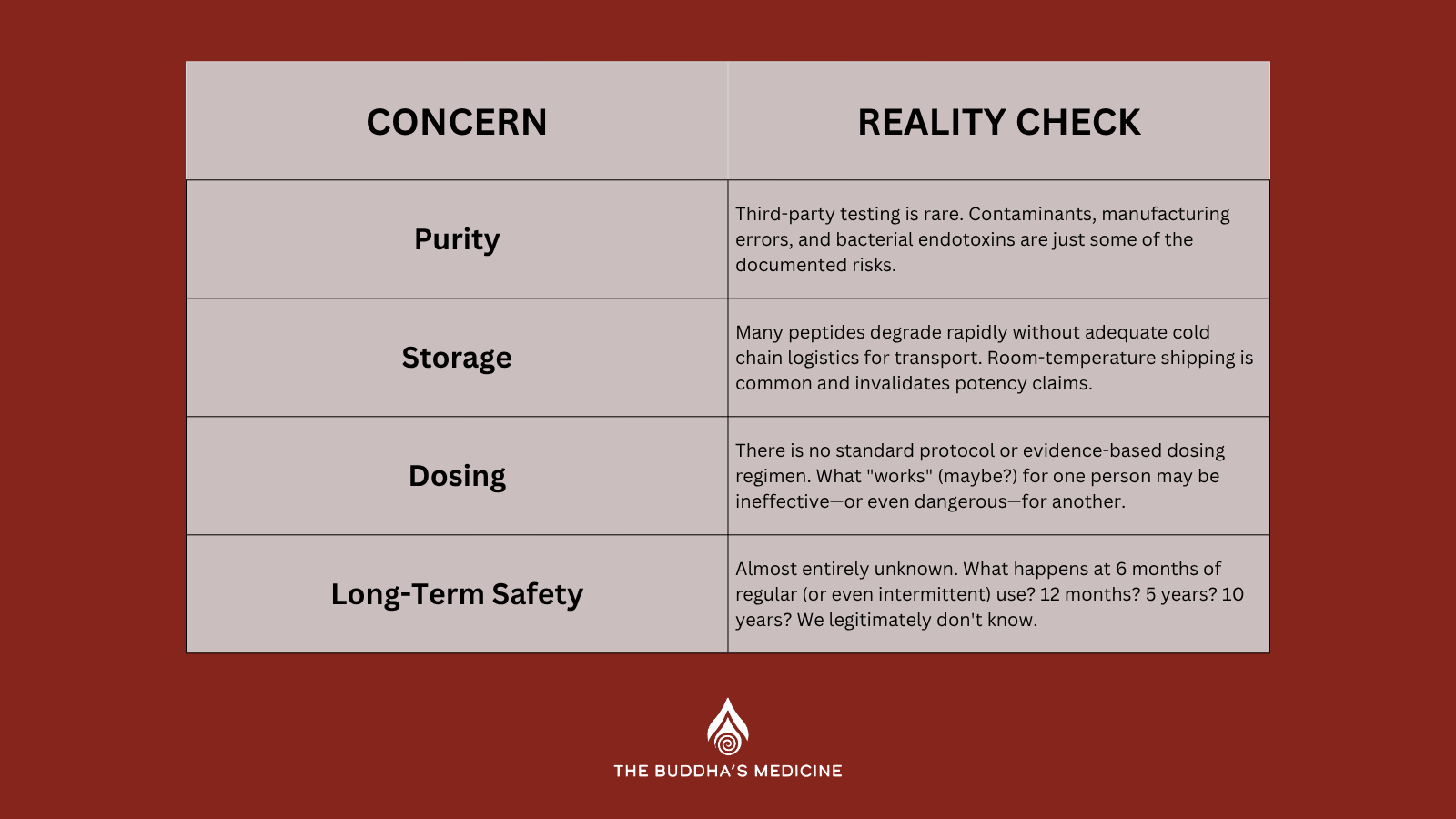
Why This Matters for All of Us
Now, I want to be clear: I'm not dismissing all peptides out of hand. As a physician trained to provide care within allopathic, integrative, and Ayurvedic frameworks in modern day American, I understand the appeal. The supposed benefits can be very attractive on paper (or on screen). For certain indications, some show some degree of promise. There is potential for genuine therapeutic breakthrough.
But "promising research" and "off-label self-administration" are not the same category. They're not even in the same county, let alone the same ballpark.
In Ayurvedic medicine, the emphasis is always on finding balance: balance in one's Agni (digestive and metabolic fire), Ojas (the resource pool of immune and resilience elements), and Doshas (clusters of related physiologic functions). Introducing a powerful exogenous compound without understanding its interaction with these principles and our body systems amounts to haphazard experimentation on yourself. Andyou cannot safely or realistically be your own clinical study control group.
We also have to acknowledge the regulatory landscape: The FDA has issued multiple warnings about compounded peptides. The compounding pharmacy system is supposed to provide oversight, but enforcement varies widely by state and facility. When the supply chain lacks transparency, the burden of safety shifts directly onto the consumer, who almost certainly doesn't have access to the kind of pharmacological data (or data interpretation skill) needed to make safe and informed decisions.
So, What Do We Actually Do About Peptides?
If you're considering using "research chemical" peptides, here's my practical advice—no sugar-coating:
Don't. Don't use them. It's not safe. It's not going to be safe until the market landscape changes.
If You Absolutely Must Use Them, Question Yourself: Is there a legitimate medical reason that I want to use something this risky? Or is this about chasing questionable gains at potentially significant cost?
If You Absolutely Must Use Them, Talk to a Licensed Healthcare Professional First. Not someone selling them, and not someone who makes money off of them. Someone with a strong ethical framework who can help you interpret existing data responsibly, who understands drug interactions, and who can monitor you clinically.
If You Absolutely Must Use Them, Demand Third-Party Testing. If the distributor can't provide certificates of analysis from an independent lab, walk away and consider other care options. Your health isn't worth the risk.
If You Absolutely Must Use Them, Start Conservatively. Only the lowest possible doses, one agent at a time. Never stack untested (or inadequately tested) compounds together.
If You Absolutely Must Use Them, Get Frequent Labwork. Baseline blood work before starting, routine follow-ups to trend your response, symptom tracking, and so on. Treat this like any other medical intervention, but even more cautiously.
And if you're leaning toward prevention, recovery, and longevity through natural pathways instead—that's even more valid. Extremely often, foundational support through sleep, exercise optimization, stress management, and targeted nutrition delivers sustained results without the unknown variables. Ayurvedic herbs, integrative treatments, and lifestyle protocols have millennia of observational history and modern evidence behind them.
That's a ton more than we can say for most peptides.
The Bottom Line
Peptides aren't inherently evil, but they are risky, and they most certainly are not magic. Peptides are just another class of tool. And just like with any tool, the outcome of its use depends on how safely, skillfully, and knowledgeably it's applied.
The current marketplace is moving fast. Breakneck fast, sometimes. Regulations are barely playing catch-up. Research is trailing (as if often does) behind demand. And every day people are left making high-stakes decisions with incomplete information.
As a licensed physician, my responsibility is to give you the full picture—not just the shiny headline. Because in integrative care, the goal isn't just to fix the symptom. It's to build lasting vitality without accepting short-term gain for long-term harm.
So if you're curious about peptides, that's great. Stay curious. But even more than that, be cautious. The best kind of healing welcomes both innovation and prudence.
And if you want to explore your health in greater depth, let's chat.

Dr. Matt Van Auken, MD, MPH
Dr. Matt is an Ayurveda-trained, triple board-certified physician.